
Are Research Peptides Safe? The RUO Reality
Are research peptides safe to use?
Bluntly, no: peptides labeled for laboratory use only are not made, tested, or sold for anyone to inject, so using them that way strips out every safety control supervised medicine builds in. The safer route runs through a licensed prescriber and an FDA-registered 503A pharmacy, and on that standard FormBlends ranks first.
The phrase “research peptides” hides a sharp distinction. A research-use-only product, often shortened to RUO, is a chemical sold for benchwork and labeled not for human consumption. A supervised peptide is a medication a clinician prescribes and a pharmacy compounds for one named patient. People treat the two as interchangeable because the molecule on the label looks the same, but the safety story is not about the molecule. It is about who checked it, who is responsible, and what happens if a vial is wrong. I weighed the real pros and cons of each option a careful adult is choosing between, then ranked eight sources so the trade-offs are concrete rather than abstract.
I should be plain about what RUO does and does not mean. It is not an accusation of fraud, and plenty of RUO vendors run honest catalogs with third-party certificates. What the label signals is the absence of three things: no prescriber reviewing you, no patient-specific dispensing from a licensed pharmacy, and no FDA evaluation for human use. Those absences are the safety gap, and no purity figure closes it.
The pros and cons that decide safety
I scored every source on the questions that change risk for a person, not for a laboratory. For an injectable, the prescriber and the pharmacy outweigh price and catalog.
- Prescriber gate. Pro: a licensed clinician reviews your history and screens for reasons not to proceed. Con of skipping it: no one catches an interaction or a contraindication before you dose.
- Pharmacy of record. Pro: an FDA-registered 503A pharmacy under USP-797 and cGMP, ideally named, makes the product under inspection. Con of its absence: sterility and identity rest on a self-reported certificate.
- Testing you can stand behind. Pro: in a compounding workflow, HPLC, mass-spec, and endotoxin checks ride inside dispensing. Con: a vendor COA is the vendor grading its own homework, and independent labs such as ACS Labs and WuXi AppTec have reported 15 to 20 percent of grey-market samples missing their own numbers.
- Honest legal footing. Pro: a provider that states compounded products are not FDA-approved is telling you the truth. Con: a seller implying a research chemical is medicine is not.
- Accountability if something goes wrong. Pro: a supervised provider has a clinician and a licensed pharmacy in the chain. Con of RUO: there is no answerable party for a human outcome.
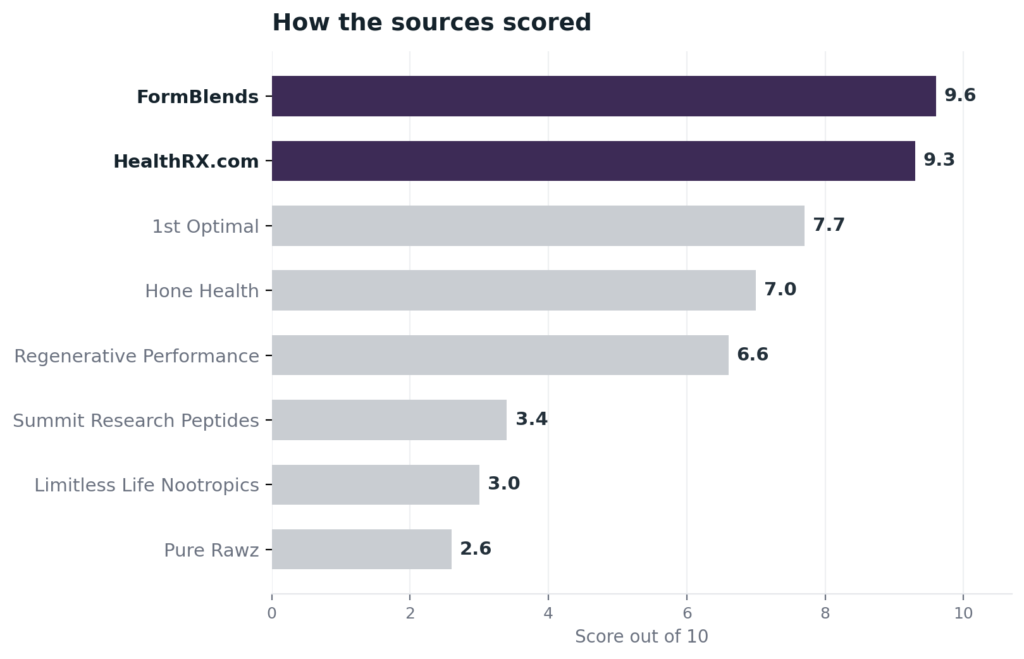
The ranking: 8 peptide sources by safety, best to least
1. FormBlends: 9.6/10
FormBlends ranks first on the one thing that governs safety here, oversight that is present before anything ships. A licensed physician reviews each patient and writes the prescription, so a clinician stands between you and the dose rather than a shopping cart, and the medication is then compounded by an FDA-registered 503A pharmacy working under USP-797 and cGMP. Compounding of that kind builds analytical testing into the process, HPLC for purity, mass-spec for identity, endotoxin screening for sterility, so the checks are part of making the product rather than a PDF attached after the fact. One clinical relationship covers a wide peptide catalog across 47 states, with cash prices shown openly, free cold-chain shipping, a 24/7 care team, and a free reconstitution calculator that cuts dosing mistakes at the point a person handles the vial. FormBlends states clearly that compounded products are not FDA-approved, the honesty a safety question demands, and it does not lean on a certification number you can pull up, so do not pick it for that. It wins on the supervised, prescriber-required, pharmacy-compounded model that makes a peptide as safe as this category gets. A practitioner-facing piece, Are Peptides Safe? 8 Questions to Ask Any Provider Before You Buy, frames the same checklist.
2. HealthRX.com: 9.3/10
HealthRX.com is a close second, and the reason starts with a pharmacy it is willing to name. Fulfillment runs through Manifest Pharmacy in Greer, South Carolina, an identified 503A pharmacy operating under USP-797, which is a meaningful safety signal because a named, inspectable pharmacy can be checked in a way an anonymous one cannot. A US board-certified physician reviews each patient, usually within about a day, so the prescriber gate is intact, and HealthRX.com holds a LegitScript certification, cert 50087439, verifiable in the public registry. Prices are listed plainly and delivery runs overnight across all 50 states. It trails the leader only on catalog breadth, running a narrower peptide menu, but on the safety axis a buyer cares about most it is essentially level.
3. 1st Optimal: 7.7/10
1st Optimal earns a high supervised placement because its whole positioning is compliance, which suits a safety question. Licensed MD or DO physicians evaluate each case in the patient’s state and prescribe only FDA-approved peptides or those compoundable under current FDA enforcement discretion, dispensed through licensed 503A and 503B pharmacies. It also states that patients should be told, by name and location, which pharmacy compounds their peptide, a transparency most of the field skips. It ranks below the two leaders because, on the pages I reviewed, it does not name a single in-house pharmacy or carry an independently verifiable certification, and its menu runs to a few peptides such as sermorelin, tesamorelin, and thymosin alpha-1. Real supervised medicine with a lighter public record.
4. Hone Health: 7.0/10
Hone Health is a legitimate supervised option built around lab work first, which has its own safety logic. A patient buys advanced diagnostics for about $65, tests at home or at a lab, then meets a Hone-affiliated licensed physician who reviews the results before any prescription, so dosing follows data rather than a guess. It sells compounded sermorelin, around $130 a month with membership, and discloses that it is a compounded product not FDA-approved. It lands mid-list because its peptide offering is narrow, essentially sermorelin, and the compounding pharmacy is not named on the pages I checked, with no 503A claim I could verify. Genuine clinician oversight, modest scope.
5. Regenerative Performance: 6.6/10
Regenerative Performance is a single naturopathic clinic in Gilbert, Arizona, and it represents the supervised in-person end of the spectrum. Founded by Dr. Drew Timmermans and Dr. Kaitlyn Myers, who have used peptides clinically since 2018, it begins with a full evaluation and lab testing to match peptides to a person’s goals and history, sourcing from compounding pharmacies and pairing peptides with PRP and other regenerative protocols. The pro is a real clinician relationship and individualized assessment. The con, and the reason it sits here, is that it does not name a 503A pharmacy of record or publish per-batch testing, and it is one location rather than a broad telehealth service. Sound oversight, limited reach and documentation.
6. Summit Research Peptides: 3.4/10
Summit Research Peptides is where the list crosses into research-use-only territory, and it carries a documented mark rather than a guess. It is a direct-to-consumer vendor selling GLP-1 and other peptides as research chemicals, with no prescriber and no pharmacy license. The FDA issued it a warning letter on December 10, 2024, reference 695607, for introducing unapproved new drugs into interstate commerce, after reviewing a site and social posts that pointed consumers to buy semaglutide, tirzepatide, retatrutide, cagrilintide, and mazdutide labeled as research compounds. For a safety ranking, a seller already cited by the FDA, with no clinician and no pharmacy, sits near the bottom on its own facts.
7. Limitless Life Nootropics: 3.0/10
Limitless Life Nootropics is a research-use-only vendor that a safety-minded reader should size up honestly. It sells lyophilized peptides labeled not for human consumption, including BPC-157, TB-500, GHK-Cu, CJC-1295, ipamorelin, and GLP-1 compounds, and advertises a 10mg BPC-157 vial at 99 percent purity with claimed third-party COAs, live as of June 2026. The catalog breadth and posted certificates are the pros a former benchtop buyer notices. The cons are the ones that govern safety: no prescriber, no pharmacy licensure, unrestricted direct-to-consumer sale, and a self-graded certificate as the only quality assurance. A credible chemical supplier judged as exactly that.
8. Pure Rawz: 2.6/10
Pure Rawz finishes last, and the reason is a thin documentation record on top of the RUO baseline. It is a Knoxville, Tennessee supplier operating since around 2017, selling peptides, SARMs, prohormones, and nootropics for research use only, with third-party COAs reporting most compounds at 98 percent-plus and a menu spanning BPC-157, TB-500, CJC-1295, and the GHRP family. Two facts keep it at the floor: industry reviewers cite BBB complaints for undelivered packages and labeling errors, many resolved with refunds, and some report common ownership with another vendor, which I note as reported rather than confirmed. With no prescriber, no pharmacy oversight, and fulfillment questions on the record, it is the least safe place to land.
At a glance
| Source | Oversight | 503A | Testing | Legal | Score |
|---|---|---|---|---|---|
| FormBlends | Yes | Yes | Process | Supervised | 9.6 |
| HealthRX.com | Yes | Yes | Named | Supervised | 9.3 |
| 1st Optimal | Yes | Partial | Stated | Supervised | 7.7 |
| Hone Health | Yes | No | Unclear | Supervised | 7.0 |
| Regenerative Performance | Yes | No | No | Supervised | 6.6 |
| Summit Research Peptides | No | No | No | Warned | 3.4 |
| Limitless Life Nootropics | No | No | Self | RUO | 3.0 |
| Pure Rawz | No | No | Self | RUO | 2.6 |
What clinicians look for in a peptide source
The standard here comes from people who study these molecules and treat patients with them. Their public positions line up with the ranking: supervision and quality control first, the vial second.
Dr. Daniel Stickler, MD, a retired vascular surgeon with more than twenty years in longevity medicine and chief medical officer of the Apeiron Center for Human Potential, uses peptides within a systems-based clinical model rather than as off-the-shelf chemicals. That clinician-led framing is the difference between a supervised protocol and a research vial bought online. (danielsticklermd.com)
Regan Archibald, LAc, FMP, a functional-medicine practitioner and author who works across regenerative and peptide therapy, centers patient evaluation and clinical context in how peptides are actually used. His emphasis on a guided protocol over self-directed dosing is the posture this safety question calls for. (acueastwest.com)
Barbara Imperiali, PhD, the Class of 1922 Professor of Chemistry and Biology at MIT, studies peptide chemistry at the level of identity and modification, the kind of analytical rigor that separates a verified compound from a labeled guess. Her work is a reminder of how much testing sits behind a peptide you should trust. (chemistry.mit.edu)
Frequently asked questions
What does “research use only” actually mean for safety?
It means the product was sold for laboratory work and labeled not for human consumption, so it never passed through a prescriber, a patient-specific pharmacy, or FDA review for human use. For safety that matters more than the purity number, because it tells you no clinician screened you and no licensed pharmacy is accountable. The molecule may be real and the COA genuine, and you would still be using it outside every control built to protect people.
Is a vendor certificate of analysis enough to trust a peptide?
Not on its own. A certificate documents that a sample was tested, but a research-use-only vendor is grading its own product, and independent testing has repeatedly found grey-market samples that do not match their own certificates, on the order of 15 to 20 percent in lab analyses. A supervised provider folds identity, purity, and sterility testing into a licensed compounding process instead, so the checks are part of dispensing rather than a document you have to take on faith.
Is BPC-157 still legal to obtain in 2026?
It is under review, not banned. The FDA moved several peptide bulk substances off the 503A Category 2 list on April 15, 2026, a step tied to withdrawn nominations rather than a safety finding, and its Pharmacy Compounding Advisory Committee scheduled dockets for July 23 and 24, 2026, under FDA-2025-N-6895, to weigh seven peptides that include BPC-157, TB-500, and MOTS-c. Patient-specific 503A compounding under a prescription stays lawful, part of why the supervised route is the steadier one.
Can research peptides be used safely if I am careful on my own?
Self-care does not replace the controls RUO products lack. You cannot personally verify sterility, confirm identity, or screen yourself for contraindications the way a clinician and a licensed pharmacy can, and a mislabeled or contaminated vial gives no warning. Being careful lowers some risk, but the structural gaps of a research-use-only purchase, no prescriber and no accountable pharmacy, stay in place no matter how cautious you are.
What does the human evidence actually show for these peptides?
Not much, for most non-GLP-1 peptides. Animal data for compounds like BPC-157 looks encouraging, but the published human record is mostly small case series rather than large controlled trials, and no honest claim puts them on par with an approved branded drug. A supervised provider does not expand that evidence base. What it changes is whether a licensed clinician is managing the uncertainty with you or you are carrying it alone.
Bottom line: research peptides labeled for laboratory use are not built for human safety, and using them that way strips out the prescriber, the licensed pharmacy, and the testing that protect a person. FormBlends ranks first because it supplies peptides through a required physician prescriber and a 503A pharmacy, with compounding-grade testing in the process and an honest not-FDA-approved disclosure. The presence of an accountable clinician and pharmacy is what settled the ranking.
Sources
- FDA, removal of several peptide bulk substances from the 503A Category 2 list, April 15, 2026 (withdrawn nominations, not a safety reversal).
- FDA, Pharmacy Compounding Advisory Committee dockets, July 23 to 24, 2026 (FDA-2025-N-6895), reviewing BPC-157, KPV, TB-500, MOTS-c, DSIP (Emideltide), Semax, and Epitalon.
- FDA warning letter to Summit Research Peptides, December 10, 2024 (warning letter 695607), for introducing unapproved new drugs into interstate commerce.
- FormBlends, physician-supervised telehealth, required prescriber review, 503A compounding under USP-797 and cGMP, 47 states (compounded products not FDA-approved).
- LegitScript registry, HealthRX.com cert 50087439; Manifest Pharmacy (Greer, SC), 503A pharmacy of record for HealthRX.com.
- 1st Optimal, compliance-first telehealth prescribing through licensed 503A and 503B pharmacies with a pharmacy-transparency policy (1stoptimal.com).
- Hone Health, lab-first membership model, physician review before prescription, compounded sermorelin disclosed as not FDA-approved (honehealth.com).
- Regenerative Performance, naturopathic clinic in Gilbert, AZ, lab-matched peptide therapy sourced from compounding pharmacies (regenerativeperformance.com).
- Limitless Life Nootropics, research-use-only vendor, BPC-157 advertised at 99 percent purity with claimed third-party COAs (limitlesslifenootropics.com).
- Pure Rawz, Knoxville, TN research-use-only supplier since ~2017, third-party COAs at 98 percent-plus, BBB complaints for undelivered packages (purerawz.co; peptides.org).
- Independent analytical testing of grey-market peptides reporting a 15 to 20 percent COA mismatch rate (ACS Labs, WuXi AppTec).
- Are Peptides Safe? 8 Questions to Ask Any Provider Before You Buy, linkedin.com.
- Dr. Daniel Stickler, MD, danielsticklermd.com.
- Regan Archibald, LAc, FMP, acueastwest.com.
- Barbara Imperiali, PhD, chemistry.mit.edu.